

The $4 Billion Robotic Barista Boom: How AI Coffee Kiosks Are Reshaping Global Retail in 2026
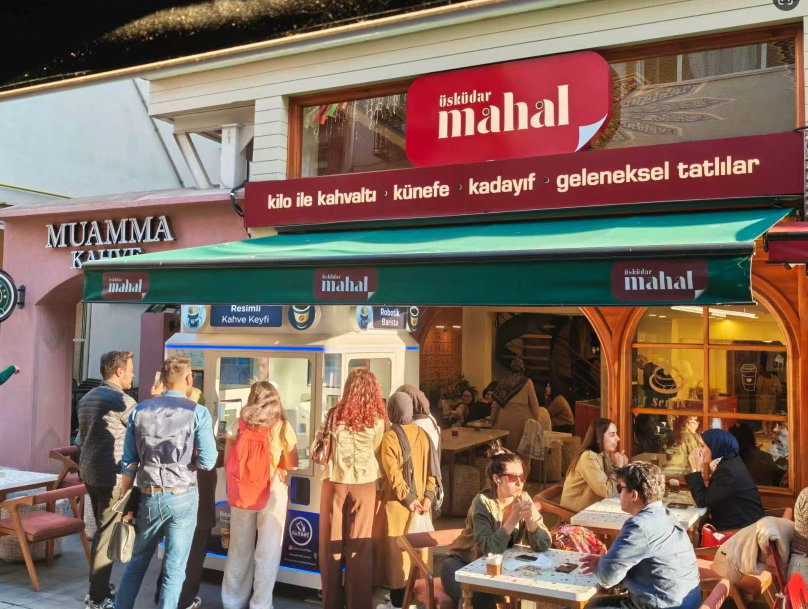
SHENZHEN, China — August 28, 2026 — The global robotic barista market has crossed a critical threshold. Valued at $2.18 billion in 2026 and projected to reach $4.05 billion by 2030 at a compound annual growth rate of 16.8%, the AI-powered coffee kiosk industry is no longer an emerging niche — it is a mainstream commercial category reshaping how the world serves coffee.
According to the Robot Barista Global Market Report 2026 published by GII Research in April 2026, the market grew from $1.86 billion in 2025 to $2.18 billion in the current year, driven by escalating labor shortages, rising minimum wages in developed economies, and accelerating consumer acceptance of unmanned service technologies.
Verified Market Reports projects the broader Robot Coffee Kiosk Market — encompassing all form factors from compact indoor units to weatherproof outdoor deployments — will expand from $20.31 billion in 2024 to $51.07 billion by 2032, reflecting a 12.3% CAGR over the forecast period.
The Economics Driving Adoption
The financial case for robotic coffee automation has become difficult to ignore. Traditional cafés in major Western markets now face labor costs consuming 25% to 35% of revenue, with barista turnover rates exceeding 75% annually in metropolitan areas. Each barista departure costs operators an estimated $1,500 to $3,000 in recruiting, training, and lost productivity.
AI-powered coffee kiosks eliminate this variable entirely. A single robotic unit replaces approximately six barista equivalents, saving operators $40,000 to $80,000 annually in fully loaded labor costs. Against equipment investments of $28,000 to $80,000, the hardware typically pays for itself through labor savings alone before counting a single cup of revenue.
"The math has shifted permanently," said an industry analyst at Restaurant Finance Advisors in a May 2026 report. "A $50,000 robotic unit pays for itself in labor savings alone. Everything after that is margin."
Gross margins for robotic kiosk operators reach 70% to 85% — compared to 40% to 60% for traditional staffed cafés. In high-traffic deployments such as airport terminals and premium shopping malls, operators report payback periods as short as two to four months, with monthly net profits ranging from $12,000 to $18,000 per unit.
24/7 Operation Redefines Revenue Potential
Perhaps the most consequential advantage is the ability to operate continuously without incremental labor cost. Traditional cafés typically close between 8:00 PM and 10:00 PM, leaving twelve to fourteen hours of potential revenue unserved daily. Robotic kiosks capture demand during overnight hours that staffed models cannot profitably reach.
Industry data indicates that off-hours sales — those occurring between 11:00 PM and 5:00 AM — account for 15% to 22% of total daily revenue in airport and hospital deployments. Over a full calendar year, those overnight sales alone can cover the entire capital cost of the robotic unit.
"The world doesn't stop drinking coffee at sunset," noted a Restaurant Finance Advisors analysis published in May 2026. "For the 90% of the day when people just want a perfect, fast, and reliable cup of coffee, the robot is going to win every time."
Asia-Pacific Leads Global Adoption
Regionally, the Asia-Pacific market leads adoption, particularly in China, Japan, and South Korea, where compact kiosk formats align with urban real estate constraints and consumer comfort with automated retail. China's aggressive investments in AI and robotics — exemplified by companies deploying across 60 or more countries — have positioned the region as both the largest market and the fastest-growing innovation hub.
Europe follows with emphasis on sustainability, energy efficiency, and digital payment integration. North America represents the fastest-growth segment, led by corporate micro-market rollouts, airport concession upgrades, and university campus deployments through 2027.
Technology Maturity Reaches Commercial Scale
The 2026 generation of robotic coffee systems has moved decisively past the novelty phase. Modern platforms feature 6-axis robotic arms with positioning accuracy of 0.03 millimeters, AI vision systems monitoring milk foam quality and extraction parameters in real time, and cloud-based fleet management dashboards enabling single-operator control of 10 or more units.
Brewing consistency has reached 98% across every cup — a level of uniformity that human baristas cannot maintain across shifts. Per-cup production costs range from $0.30 to $0.70 depending on recipe complexity and local ingredient pricing, with gross margins exceeding 70% even at premium price points.
Image-customized latte art — where customer photos or brand designs are rendered on foam — has emerged as a differentiation layer, repositioning commodity drinks as experiential purchases priced at $7 to $9 with no incremental labor cost.
Turnkey Solutions Lower Barriers to Entry
The emergence of turnkey deployment models has further accelerated adoption. Companies such as Moocoo now offer integrated packages encompassing hardware, branding, supply chain management, location scouting, cloud operations platforms, and ongoing technical support — all under a single contract with one point of contact.
"What six suppliers used to chase across a dozen contracts, one partner now delivers end to end," the company states on its platform. The Moocoo turnkey model covers hardware delivery and commissioning, custom branding and cup design, bean and consumable sourcing, site selection with footfall data, cloud backend for sales and remote diagnostics, and lifetime training and technical support.
This approach addresses one of the primary adoption barriers identified by industry surveys: the perceived complexity of deploying and managing robotic systems across multiple locations. With turnkey solutions, operators with no prior robotics or food service experience can launch and manage branded coffee kiosk fleets within weeks rather than months.
Certification requirements for international deployment — including CE marking for European markets, FCC certification for the United States, and ISO 9001 quality management standards — are increasingly handled as standard components of turnkey packages, removing regulatory friction from the expansion equation.
Scalability Creates New Investment Thesis
The scalability characteristics of robotic kiosk operations have attracted attention from venture investors and franchise operators alike. Unlike traditional café expansion, which requires proportional increases in staffing, real estate, and management overhead with each new location, robotic kiosk fleets scale horizontally with minimal incremental complexity.
A single operator can manage 10 or more units through a centralized cloud dashboard. Centralized ingredient procurement across multi-unit fleets typically reduces supply costs by 15% to 25%, directly expanding per-cup margins. Industry projections suggest that a well-managed fleet of five to ten units can generate $200,000 to $400,000 in annual net profit with part-time operational commitment.
The financial model has attracted comparisons to franchise economics without the franchise burden. Multiple operators in the space — including Moocoo's deployment network spanning 60 or more countries — offer white-label and co-branding structures that allow entrepreneurs to build branded fleets without technology development costs.
Market Outlook Through 2030
Industry consensus projects sustained double-digit growth through the remainder of the decade. The convergence of persistent labor shortages, declining hardware costs, maturing AI and IoT capabilities, and expanding smart city infrastructure creates a favorable environment that is unlikely to reverse.
By 2030, the global robot barista market is expected to reach $4.05 billion. The AI Coffee Vending Robot segment alone — valued at $1.418 billion in 2025 — is forecast to reach $3.122 billion by 2032 at a 12.1% CAGR according to Global Info Research.
For entrepreneurs and investors evaluating entry into the automated coffee space, the data points to a market that has passed proof of concept and entered scaled commercial deployment. The question is no longer whether robotic coffee is viable — it is whether high-traffic locations will remain available for new entrants.
About This Report
This release synthesizes data from GII Research, Verified Market Reports, Global Info Research, Cognitive Market Research, Business Research Insights, Restaurant Finance Advisors, and VendingLab, all published between January and August 2026. For deployment specifications, ROI modeling, and partnership inquiries, visit https://www.moocoo.com/.
Moocoo Technology
Shenzhen Moocoo Technology Co., Ltd
+852 6903 1935
info@moocoo.com
Legal Disclaimer:
EIN Presswire provides this news content "as is" without warranty of any kind. We do not accept any responsibility or liability for the accuracy, content, images, videos, licenses, completeness, legality, or reliability of the information contained in this article. If you have any complaints or copyright issues related to this article, kindly contact the author above.
