

Global Cobots for Pharmaceutical Dispensing Market Dominated by U.S. Innovation as FANUC Corporation, Yaskawa Electric
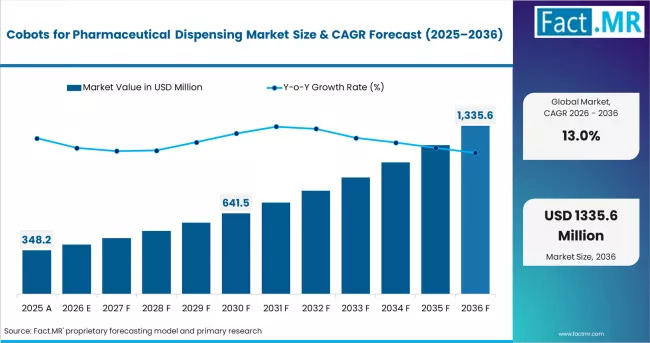
Cobots for Pharmaceutical Dispensing Market
Automation-led pharma dispensing evolves with precision dosing, sterile compliance, and digital integration, driving scalable, long-term growth through 2036.
ROCKVILLE, MD, UNITED STATES, April 13, 2026 /EINPresswire.com/ -- According to the latest analysis by Fact.MR, the global cobots for pharmaceutical dispensing market is undergoing a structural transformation driven by precision automation and regulatory compliance requirements.Market valued at USD 312.6 million in 2025
Estimated to reach USD 348.2 million in 2026
Forecast to expand to USD 1,180 million by 2036
CAGR of 13% (2026–2036)
Incremental opportunity of USD 831.8 million
Get detailed market forecasts, competitive benchmarking, and pricing trends: https://www.factmr.com/connectus/sample?flag=S&rep_id=14697
The market is evolving from manual dispensing systems toward collaborative robotic platforms that ensure dosing accuracy, contamination control, and workflow standardization. Germany emerges as a key European hub, supported by Industry 4.0 initiatives and strong pharmaceutical manufacturing infrastructure.
Quick Stats
Market Size (2026): USD 348.2 million
Market Size (2025): USD 312.6 million
Forecast Value (2036): USD 1,180 million
CAGR (2026–2036): 13%
Incremental Opportunity: USD 831.8 million
Leading Segment: Dispensing Function (39% share)
Leading Payload: Up to 5 kg (41% share)
Leading Region: Asia Pacific (growth), Europe (value & compliance leadership)
Key Players: ABB Ltd., KUKA AG, Universal Robots A/S, FANUC Corporation, Yaskawa Electric Corporation
Executive Insight for Decision Makers
The market is shifting from labor-intensive pharmaceutical workflows to digitally integrated robotic dispensing systems.
Strategic Imperatives:
Invest in precision-engineered cobots aligned with dosing accuracy requirements
Strengthen software integration with pharmacy information systems
Prioritize regulatory compliance (EU GMP, Annex 1) in automation design
Develop modular, scalable robotic solutions for flexible deployment
Risk of Inaction:
Increased variability in dosing accuracy
Higher contamination risks in sterile environments
Reduced competitiveness in automated pharmaceutical production
Market Dynamics
Key Growth Drivers
Rising demand for dose precision and repeatability
Increasing adoption of sterile and aseptic automation systems
Expansion of pharmaceutical manufacturing capacity
Integration with digital traceability and batch documentation systems
Key Restraints
High initial investment and integration costs
Lengthy validation and regulatory approval timelines
Compatibility challenges with legacy pharmacy systems
Emerging Trends
Adoption of AI-enabled robotic vision systems
Growth in compact, cleanroom-compatible cobots
Expansion of robot-as-a-service (RaaS) models
Integration with Industry 4.0 and smart manufacturing platforms
Segment Analysis
Leading Segment:
Dispensing function holds 39% market share, driven by demand for precise dosage control
By Payload Capacity:
Up to 5 kg dominates with 41% share, enabling high-precision handling of lightweight pharmaceutical containers
Fastest-Growing Segment:
Packaging and labeling automation in pharmaceutical manufacturing
Application Breakdown:
Hospital pharmacies
Pharmaceutical manufacturing facilities
Compounding pharmacies
Research laboratories
Strategic Importance:
Low payload, high-precision cobots are critical for cleanroom environments and small-batch pharmaceutical workflows, particularly in Germany’s regulated ecosystem.
Supply Chain Analysis (Critical Insight)
Raw Material Suppliers
Sensors, actuators, servo motors, control units, and machine vision components
Manufacturers / Producers
Robotics OEMs producing collaborative robots and automation platforms
System Integrators / Distributors
Automation solution providers integrating cobots into pharmaceutical workflows
Software providers enabling connectivity with ERP and pharmacy systems
End-Users
Pharmaceutical manufacturers
Hospital and retail pharmacies
Contract manufacturing organizations (CMOs)
Research labs
Who Supplies Whom:
Component suppliers → Robotics OEMs
OEMs → Automation integrators
Integrators → Pharmaceutical companies & pharmacies
Germany plays a pivotal role as a high-value integration hub, where advanced robotics engineering meets pharmaceutical compliance requirements.
Pricing Trends
Commodity vs Premium:
Entry-level cobots compete on cost efficiency
Premium systems command higher pricing due to precision, compliance, and software integration
Key Price Influencers:
Raw material and component costs
Customization and integration complexity
Regulatory certification requirements
Demand for cleanroom-compatible systems
Margin Insights:
Higher margins in customized pharmaceutical automation solutions
Lower margins in standardized robotic units
Regional Analysis
Top 5 Countries by CAGR (2026–2036)
China – 14.2%
India – 13.9%
United Kingdom – 13.6%
Germany – 13.3%
United States – 13.0%
Germany Focus
Strong adoption driven by Industry 4.0 strategy
Advanced robotics engineering ecosystem
High emphasis on quality control and compliance
Regional Insights
Europe: Compliance-driven, high-value adoption
Asia Pacific: Manufacturing expansion and rapid automation
North America: Mature market with replacement-driven demand
Developed vs Emerging Markets:
Developed markets prioritize precision and compliance
Emerging markets focus on cost-effective automation scaling
Competitive Landscape
Market Structure: Moderately concentrated
Key Players:
ABB Ltd.
KUKA AG
Universal Robots A/S
FANUC Corporation
Yaskawa Electric Corporation
Omron Corporation
Denso Corporation
Stäubli International AG
Techman Robot Inc.
Doosan Robotics Inc.
Competitive Strategies:
Product innovation in precision robotics
Expansion of pharmaceutical-specific solutions
Strategic partnerships with automation integrators
Focus on user-friendly programming interfaces
Strategic Takeaways
For Manufacturers
Invest in cleanroom-compatible, high-precision cobots
Expand modular automation platforms
For Investors
Target companies with strong integration and software capabilities
Focus on markets with regulatory-driven demand (Germany, UK)
For Marketers / Distributors
Highlight compliance, traceability, and ROI benefits
Build partnerships with pharma automation integrators
Future Outlook
The market is expected to transition toward:
Fully automated pharmaceutical dispensing ecosystems
Integration of AI, machine learning, and predictive analytics
Expansion of sustainable and contamination-free production systems
Germany is poised to remain a center of excellence for pharmaceutical robotics, leveraging its engineering capabilities and regulatory leadership.
Unlock 360° insights for strategic decision making and investment planning: https://www.factmr.com/checkout/14697
To View Our Related Report:
Bioinformatics Service Market:https://www.factmr.com/report/bioinformatics-service-market
Transforming Growth Factor Market: https://www.factmr.com/report/transforming-growth-factor-market
Demand for Thyroid Cancer Diagnostics in UK: https://www.factmr.com/report/united-kingdom-thyroid-cancer-diagnostics-market
Demand for Therapeutic Drug Monitoring in UK: https://www.factmr.com/report/united-kingdom-therapeutic-drug-monitoring-market
S. N. Jha
Fact.MR
+1 628-251-1583
email us here
Legal Disclaimer:
EIN Presswire provides this news content "as is" without warranty of any kind. We do not accept any responsibility or liability for the accuracy, content, images, videos, licenses, completeness, legality, or reliability of the information contained in this article. If you have any complaints or copyright issues related to this article, kindly contact the author above.
