

Linerless Labels Market 2026-2036 | North America & Europe Demand with Top Companies Avery Dennison, UPM Raflatac
Linerless Label Market
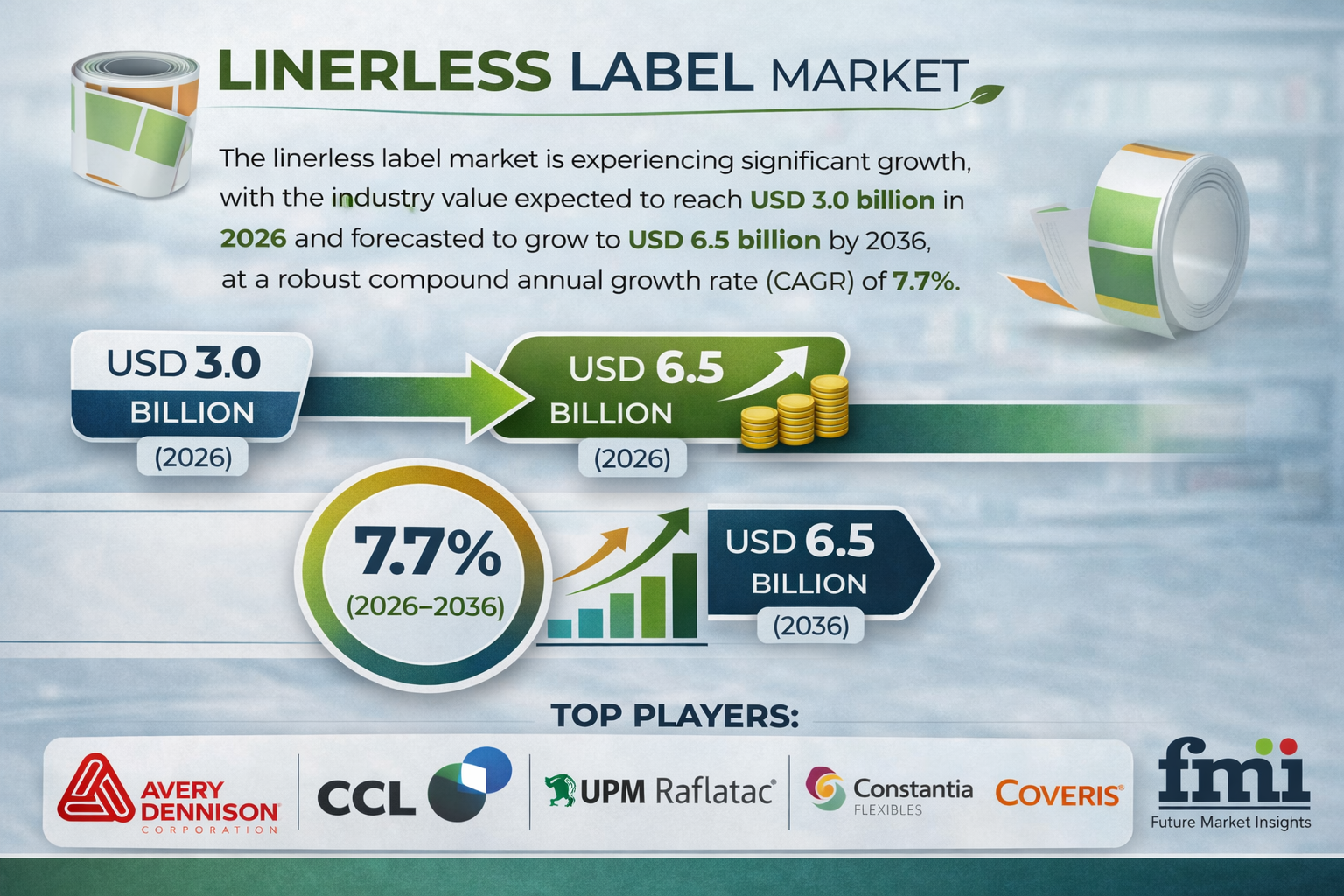
The Linerless Labels Market Expected to Reach USD 3.0 billion in 2026 and forecasted to grow to USD 6.5 billion by 2036, at a 7.7% CAGR
NEW YORK, DE, UNITED STATES, March 26, 2026 /EINPresswire.com/ -- The global linerless label market is witnessing strong momentum as industries pivot toward sustainable, material-efficient labeling solutions. Valued at USD 3.0 billion in 2026, the market is projected to reach USD 6.5 billion by 2036, expanding at a CAGR of 7.7%, according to the latest insights from Future Market Insights (FMI).
The shift toward linerless labels eliminating the need for release liners is rapidly transforming labeling economics and environmental impact. As organizations intensify efforts to reduce waste and carbon emissions, linerless technology is emerging as a strategic enabler of sustainable packaging systems.
Sustainability and Efficiency Drive Market Expansion:
The primary growth catalyst for the linerless label market is its ability to significantly reduce material waste while improving operational efficiency. By removing the liner component, businesses benefit from:
• Reduced raw material consumption and landfill waste
• Higher roll capacity, enabling longer production runs
• Lower transportation and storage costs
• Improved application speed in automated systems
Industries such as food & beverage, logistics, and retail are increasingly integrating linerless labels into their operations to align with corporate sustainability targets and regulatory mandates. In particular, the food industry’s push for eco-conscious packaging, combined with stringent labeling requirements, is accelerating adoption across fresh produce, meat, bakery, and deli applications.
Technological Advancements Strengthen Market Adoption:
Innovation in adhesive formulations and label materials is playing a critical role in expanding the application scope of linerless labels.
Key technological developments include:
• High-performance pressure-sensitive adhesives for consistent application
• Enhanced release coating technologies improving print reliability
• Compatibility with thermal printing systems and automated labeling equipment
• Improved durability for use in high-speed packaging environments
These advancements are addressing historical limitations and enabling linerless labels to perform effectively across a wider range of industries and conditions. Primary labels continue to dominate the market, accounting for 48% of total share, driven by their essential role in product identification and high-volume labeling operations.
Get Access of Research Report Sample: https://www.futuremarketinsights.com/reports/sample/rep-gb-1822
Emerging Trends: Retail Automation and Smart Labeling:
The linerless label market is evolving beyond basic labeling into integrated, high-performance systems aligned with modern supply chains.
Key trends shaping the market include:
• Rising adoption of automated print-and-apply systems in retail and logistics
• Increasing demand for variable information labeling for traceability and compliance
• Focus on cold-chain compatible adhesives for frozen and perishable goods
• Growing importance of real-time data integration and labeling accuracy
As e-commerce and quick-commerce models expand globally, linerless labels are becoming essential for efficient, scalable, and error-free labeling operations.
Regional Insights: Asia-Pacific Leads High-Growth Markets
Geographically, demand for linerless labels is expanding across major global regions, with Asia-Pacific emerging as a key growth engine.
• Asia-Pacific leads growth, driven by rapid retail expansion, e-commerce penetration, and manufacturing scale in China and India
• North America maintains strong demand due to advanced retail systems and regulatory compliance requirements
• Europe emphasizes sustainability, with strict environmental regulations accelerating adoption
China (8.6% CAGR) and India (8.3% CAGR) are at the forefront of this transformation, supported by expanding retail infrastructure and increasing demand for efficient labeling solutions.
Competitive Landscape: Innovation and Integration Define Leadership:
The linerless label market is moderately consolidated, with leading players focusing on technology integration, sustainability, and system compatibility.
Key companies include:
Avery Dennison Corporation, CCL Industries, UPM Raflatac, Constantia Flexibles Group, Coveris Holdings, HERMA GmbH, 3M Company, Ritrama S.p.A., Optimum Group, Ravenwood Packaging
Market leaders are investing in:
• Advanced linerless coating technologies
• Partnerships with OEMs for equipment compatibility
• Development of eco-friendly and lightweight label constructions
• Expansion of automated labeling platforms and applicators
Specialized players are further driving innovation in adhesive performance and customization, particularly in European and high-precision markets.
Analyst Perspective: Linerless Labels Redefine Packaging Economics According to FMI, linerless labels are transitioning from a niche solution to a mainstream labeling standard, particularly in high-volume and sustainability-driven industries.
“The elimination of liner waste fundamentally changes cost structures and operational efficiency. Companies that integrate linerless systems into automated workflows will gain a measurable competitive advantage,” notes an FMI analyst. As regulatory pressures intensify and sustainability becomes a procurement priority, linerless labels are expected to play a central role in future-ready packaging strategies.
Future Outlook: Strong Opportunities Across Retail and Logistics
The linerless label market is poised for sustained growth through 2036, supported by:
• Expansion of global retail and food supply chains
• Increasing demand for sustainable packaging alternatives
• Growth in e-commerce and logistics labeling applications
• Continuous innovation in adhesive and printing technologies
For stakeholders, the market offers compelling opportunities, particularly in emerging economies and automated retail environments, where efficiency and sustainability are critical success factors.
FAQs:
What is the market size in 2026?
USD 3.0 billion
What will the market reach by 2036?
USD 6.5 billion
What is the CAGR?
7.7%
Which segment dominates?
Primary labels
Key trend?
Shift toward sustainable, liner-free labeling solutions
Why FMI: https://www.futuremarketinsights.com/why-fmi
Have a Look at Related Research Reports on the Packaging Domain:
Labeling Software Market: https://www.futuremarketinsights.com/reports/labeling-software-market
Labels Market: https://www.futuremarketinsights.com/reports/labels-market
GMO Labelling Market: https://www.futuremarketinsights.com/reports/gmo-labelling-market
Label Applicators Market: https://www.futuremarketinsights.com/reports/label-applicators-market
GHS Label Market: https://www.futuremarketinsights.com/reports/ghs-labels-market
About Future Market Insights (FMI)
Future Market Insights, Inc. (FMI) is an ESOMAR-certified, ISO 9001:2015 market research and consulting organization, trusted by Fortune 500 clients and global enterprises. With operations in the U.S., UK, India, and Dubai, FMI provides data-backed insights and strategic intelligence across 30+ industries and 1200 markets worldwide.
Sudip Saha
Future Market Insights Inc.
+1 347-918-3531
email us here
Legal Disclaimer:
EIN Presswire provides this news content "as is" without warranty of any kind. We do not accept any responsibility or liability for the accuracy, content, images, videos, licenses, completeness, legality, or reliability of the information contained in this article. If you have any complaints or copyright issues related to this article, kindly contact the author above.
