

Global trade redirection: tracking the role of trade diversion from US tariffs in Chinese export developments
Prepared by Julien Le Roux and Tajda Spital
Published as part of the ECB Economic Bulletin, Issue 1/2026.
Global trade flows were reshaped in 2025 following the introduction of new US tariffs. US import growth weakened sharply, reflecting a strong decline in imports from China. Meanwhile, Chinese exports have surprised to the upside overall, with broad-based growth across destinations outside the United States. A key question is whether this resilience reflects trade diversion in response to the US tariffs, i.e. the reallocation of exports originally destined for one market towards alternative markets, or other adjustment mechanisms, such as rerouting through intermediary countries. However, it may still be too early to assess the full extent of tariff-induced trade redirection, as anticipatory behaviour, implementation lags at customs, shipping delays and other factors can all affect how long it takes for tariff changes to be reflected in observed trade flows. This box reviews developments in Chinese exports in 2025 and provides initial empirical evidence on whether US tariffs have triggered trade diversion.
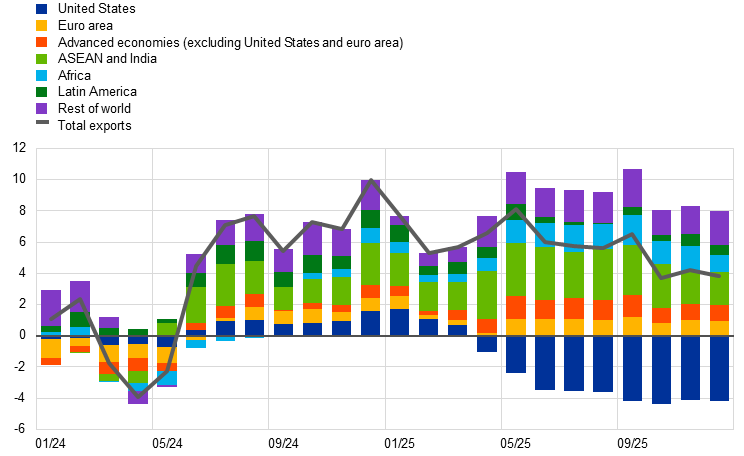
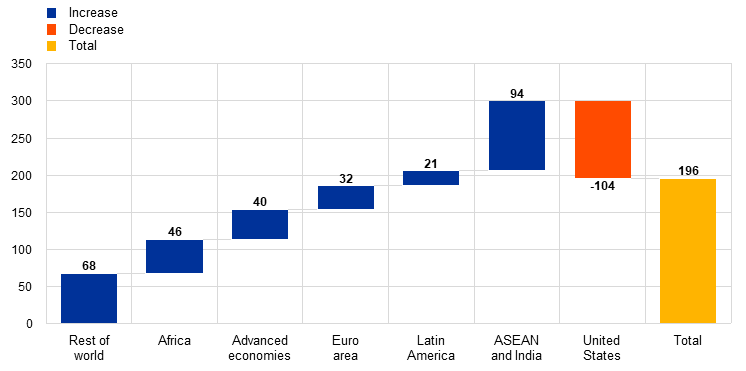
Chinese export performance remained strong in 2025, although with marked divergence across destination markets. The value of Chinese exports grew by 5.5% in 2025, compared with 4.6% in 2024. While exports to the United States declined by 20%, export growth to all other regions remained robust, increasing by 8% for the euro area, 13% for countries in the Association of Southeast Asian Nations (ASEAN), 7% for Latin America, and 26% for Africa (Chart A, panel a). In value terms, China’s exports to the United States in 2025 were USD 104 billion lower than in 2024 (Chart A, panel b). This decline was broadly comparable with the increase in exports to ASEAN countries. Exports to the euro area rose more moderately, by about USD 32 billion, while exports to Africa expanded by USD 46 billion, a sizeable increase relative to the region’s GDP.
Chart A
China’s nominal exports
a) Annual growth rate
(annual percentage changes; percentage point contributions)
b) 2025 vis-à-vis 2024
(year-on-year changes in USD billions)
Sources: General Administration of Customs of the People’s Republic of China and ECB staff calculations.
Notes: The charts are based on nominal trade data measured in US dollars. The latest observation is for December 2025.
We assess whether US tariffs have led to trade diversion of Chinese exports by capturing variations in tariff exposure across products in a product-level panel model with fixed effects. We carry out a panel regression relating the year-on-year growth rate of Chinese exports at the product level to product-level tariff variation, while controlling for an extensive set of fixed effects that capture product-specific and destination-specific trends.[1] The model is estimated using data on global imports of Chinese products over the period January-September 2025.[2]
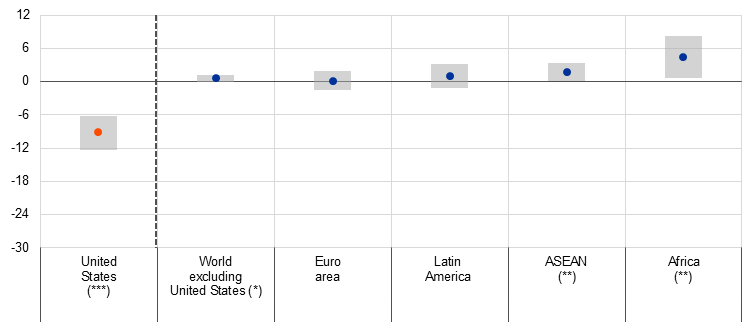
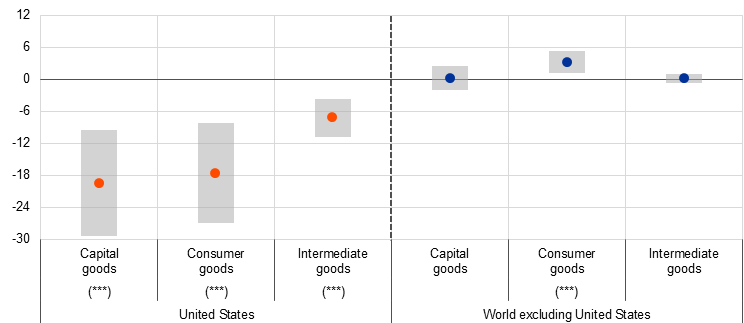
Although the US tariffs imposed on Chinese goods had a strong negative direct effect on China’s exports to the United States, evidence of broad-based trade diversion remains limited. Empirical analyses of the 2025 tariff episode are still scarce, and existing assessments rely on early evidence. Our model estimates suggest that the tariffs reduced US imports from China by around 9% (Chart B, panel a), while the observed year-on-year decline in the trade data reached approximately 17% over the first nine months of 2025.[3] This gap suggests that factors other than tariffs, such as heightened policy uncertainty, frontloading of imports ahead of tariff increases, weaker US demand or the slight appreciation of the renminbi against the US dollar, also contributed to the contraction in Chinese exports to the United States. At the same time, evidence of trade diversion effects to other markets is limited. A statistically significant positive effect is identified only for African and ASEAN countries, while the estimated impact on the euro area is modest and statistically insignificant. Disaggregating by product category, the negative effects of US tariffs are most pronounced for capital goods, followed by consumer goods and intermediate goods (Chart B, panel b). At this more granular level, some evidence of trade diversion emerges, particularly for consumer goods, where higher US tariffs on Chinese products are associated with increased exports to other markets.
Chart B
Impact of the 2025 US tariffs on Chinese exports
a) By destination
(percentage deviation between December 2024 and September 2025)
b) By category
(percentage deviation between December 2024 and September 2025)
Sources: Trade Data Monitor and ECB staff calculations.
Notes: The charts show the percentage changes of Chinese exports as a result of the 2025 US tariffs. The impact is calculated by applying the average tariff rate increase observed between the end of 2024 and September 2025, expressed in percentage point differences, to the estimated elasticity of exports with respect to tariffs. On average, US tariffs on Chinese exports rose by 37 percentage points over this period. The grey bars represent 95% confidence intervals around the estimated coefficients, while (*), (**) and (***) denote 10%, 5% and 1% significance levels respectively. The sample of estimation includes data on global imports of Chinese goods between January and September 2025. The latest observation is for September 2025.
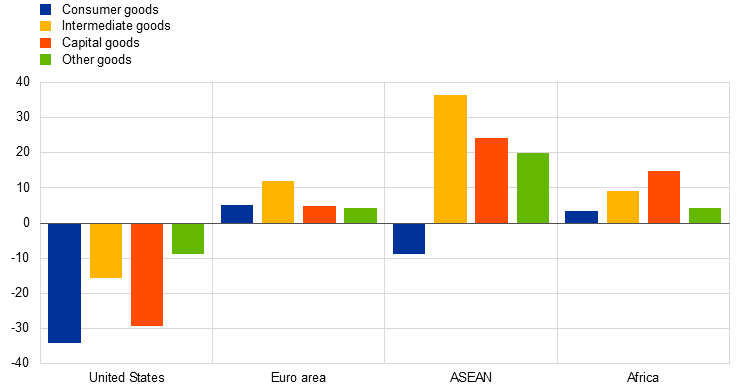
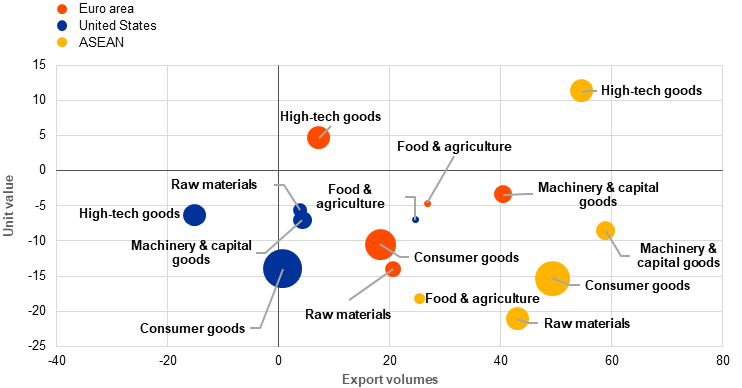
The limited but significant Chinese trade diversion toward ASEAN countries following tariffs may reflect broader trade rerouting patterns. Trade rerouting occurs when exports are redirected through intermediary countries but ultimately reach the original destination market. Notably, Chinese exports to ASEAN countries have surged, particularly in intermediate goods used for further processing or assembly (Chart C, panel a). This trend aligns with the increase in US imports from ASEAN countries, which is the only region that contributed positively to US import growth in 2025 overall. Sectoral data also indicate a sharp rise in Chinese export volumes to ASEAN countries, accompanied by declining unit values for most sectors – a pattern consistent with a greater integration of lower-value intermediate inputs into regional production chains (Chart C, panel b). Taken together, these developments suggest that ASEAN-centred supply chains played a role in the adjustment, although the evidence remains preliminary.
Chart C
Chinese export developments, January-November 2024 to January-November 2025
a) By category
(changes in USD billions)
b) By trading partner and sector
(percentage changes)
Sources: Trade Data Monitor and ECB staff calculations.
Notes: Panel a) reflects the changes in total Chinese exports during the first 11 months of 2025 compared with the same period in 2024. Panel b) shows the changes in Chinese export volumes and export unit values (in US dollars) during the first 11 months of 2025 for each trading partner and each sector. The size of the bubbles is proportional to the average corresponding trade value during the same months from 2022 to 2024. The high-tech goods list is based on the European Commission’s definition. The latest observation is for November 2025.
Overall, trade diversion accounts for only a limited role in recent Chinese export dynamics, with other factors playing a more prominent role. While part of the decline in Chinese exports to the United States can be attributed to the new tariffs, thus far there is little evidence that these measures have led to substantial trade diversion towards other markets. Any tariff-related diversion appears modest and confined to a narrow set of products, indicating limited spillovers from US tariffs to third destinations. Instead, the recent strength of Chinese exports to other markets seems to have been driven by trends that predate the latest tariff measures, as evidenced by broad-based export growth across major regions. Several factors underpin these trends. Weak domestic demand has pushed Chinese firms to channel excess capacity abroad, supported by falling export prices, competitiveness gains reinforced by a weak currency, and state-led expansion of manufacturing capacity.[4] Deeper supply chain integration within Asia has also supported exports to regional partners.
References
Al-Haschimi, A., Dvořáková, N., Le Roux, J. and Spital, T. (2025), “China’s growing trade surplus: why exports are surging as imports stall”, Economic Bulletin, Issue 7, ECB.
Amiti, M., Redding, S. J. and Weinstein, D. E. (2019), “The Impact of the 2018 Tariffs on Prices and Welfare”, Journal of Economic Perspectives, Vol. 33, No 4, pp. 187-210.
Cigna, S., Meinen, P., Schulte, P. and Steinhoff, N. (2022), “The impact of US tariffs against China on US imports: Evidence for trade diversion?”, Economic Inquiry, Vol. 60, No 1, pp. 162-173.
Legal Disclaimer:
EIN Presswire provides this news content "as is" without warranty of any kind. We do not accept any responsibility or liability for the accuracy, content, images, videos, licenses, completeness, legality, or reliability of the information contained in this article. If you have any complaints or copyright issues related to this article, kindly contact the author above.
