

In‑Wheel Motor Hub Couplings Market Forecast 2026-2036: Global Market to Reach 903.5 Billion by 2035 at ~18.9 % CAGR
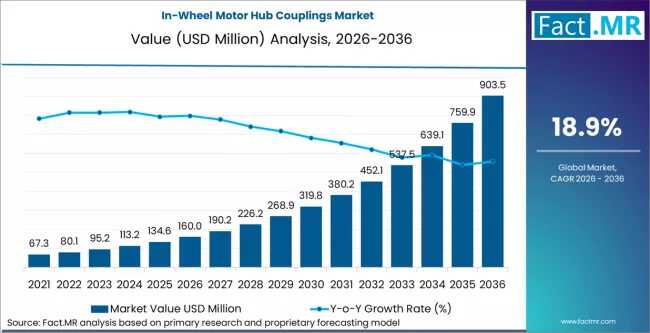
In‑Wheel Motor Hub Couplings Market
The Passenger EVs segment leads demand with a 59% market share, while the Integrated Hub Module design approach holds 53% of the market (by 2026).
ROCKVILLE, MD, UNITED STATES, February 19, 2026 /EINPresswire.com/ -- The global In-Wheel Motor Hub Couplings Market is valued at USD 160 million in 2026 and is projected to surge to USD 903.5 million by 2036. Growing at a compound annual growth rate (CAGR) of 18.9%, the market is undergoing a transformational shift as electric vehicle (EV) adoption and the deployment of specialized in-wheel motor technologies accelerate worldwide.Get Access of Report Sample : https://www.factmr.com/connectus/sample?flag=S&rep_id=14266
In-Wheel Motor Hub Couplings Market Snapshot
Market size 2026? The market is estimated to be valued at USD 160 million.
Market size 2036? The market is projected to reach USD 903.5 million.
CAGR? The market will grow at a compound annual growth rate of 18.9% (2026–2036).
Leading product segment(s) and shares? The Passenger EVs segment leads demand with a 59% market share, while the Integrated Hub Module design approach holds 53% of the market (by 2026).
Leading material type and share? Precision-engineered alloys and advanced vibration-dampening composites dominate the sector to handle high torque.
Leading end use and share? OEM / Line-Fit solutions represent the primary sales channel for integrated hub systems.
Key growth regions? China (21.3% CAGR), Brazil (21.0% CAGR), and the USA (18.3% CAGR).
Top companies? Protean Electric Limited, Elaphe Propulsion Technologies Ltd., Schaeffler AG, ZF Friedrichshafen AG, and Nidec Corporation.
Market Momentum (YoY Path)
The In-Wheel Motor Hub Couplings Market is set for consistent value appreciation over the next decade. Starting from its 2026 valuation of USD 160 million, the market is expected to witness steady gains as pilot programs transition into series production. Key milestones include a projected climb through 2028, 2030, 2031, and 2033 as manufacturing costs are optimized and in-wheel motor technology matures. The market is ultimately projected to culminate in the 2036 forecast of USD 903.5 million, reflecting a transformative growth trajectory with an absolute dollar growth of USD 649 million from 2027 to 2036.
Why the Market is Growing
The primary catalyst for the In-Wheel Motor Hub Couplings Market is the global expansion of electric vehicle manufacturing and the shift toward decentralized powertrain architectures. In-wheel motors eliminate the need for traditional drive shafts and differentials, requiring high-precision hub couplings to manage the direct motor-to-wheel interface. Increasing demand for space optimization, enhanced vehicle performance, and the electrification of passenger fleets further supports the adoption of these specialized mechanical components.
Segment Spotlight
1) Vehicle Type (Passenger EVs 59%)
The Passenger EVs segment is the dominant force in the market, projected to hold 59% share by 2026. As EV manufacturers focus on improving overall performance and energy efficiency, in-wheel motors are becoming a critical design element. These couplings are essential for integrating motors seamlessly into the vehicle drivetrain, offering better power delivery and regenerative braking capabilities.
2) Design Approach (Integrated Hub Module 53%)
The Integrated Hub Module approach is expected to capture 53% of the market share by 2026. This design consolidates the motor, controller, and coupling into a single unit, providing a streamlined and weight-efficient solution. This approach is highly attractive for automakers looking to simplify the assembly process and minimize the number of individual drivetrain components.
3) Program Stage (Early Series to Series Production)
The market is currently moving from the Pilot/Trials and Early Series stages toward full Series Production. While innovation is promising, the sector is increasingly focused on overcoming technical integration challenges such as unsprung mass and complex sealing, ensuring that hub couplings can withstand the rigorous standards of high-volume automotive manufacturing.
Drivers, Opportunities, Trends, Challenges
Drivers: The rapid adoption of electric vehicles and the push for higher energy efficiency are the main drivers. As select EV platforms experiment with in-wheel motor architectures, specialized In-Wheel Motor Hub Couplings are required to manage high torque loads and vibration while enabling compact vehicle packaging.
Opportunities: The rise of autonomous platforms and the demand for torque vectoring present significant opportunities. Regional innovation is particularly strong in markets like China and Japan, where research into decentralized drives is more advanced than in regions where centralized motor designs remain dominant.
Trends: There is a clear trend toward the integration of advanced motor and coupling technologies. Manufacturers are prioritizing ""drop-in"" high-performance platforms that allow for smoother torque delivery and improved vehicle handling, reflecting a transition toward precision-engineered, multi-functional wheel-end modules.
Challenges: High manufacturing costs and supply chain complexities remain significant restraints. Additionally, the technical difficulty of managing unsprung weight and meeting strict regulatory compliance pressures keeps the engineering threshold high, potentially limiting widespread uptake in the near term.
Country Growth Outlook (CAGR)
Country CAGR (2026–2036)
China 21.3%
Brazil 21.0%
USA 18.3%
Germany 18.1%
South Korea 18.0%
United Kingdom 18.0%
Japan 17.2%
Competitive Landscape
The In-Wheel Motor Hub Couplings Market is characterized by intense competition among technology leaders focusing on high-performance electrification. Protean Electric Limited and Elaphe Propulsion Technologies Ltd. are advancing industrialised architectures, such as the ProteanDrive Gen 5 and Sonic X platforms. Established Tier-1 suppliers including Schaeffler AG, ZF Friedrichshafen AG, Nidec Corporation, and Robert Bosch GmbH are innovating in the integration of precision-engineered solutions for durable and reliable power transmission in next-generation electric drivetrains.
Browse Full Report : https://www.factmr.com/report/in-wheel-motor-hub-couplings-market
To View related report :
Micro Motor Market
https://www.factmr.com/report/95/micro-motor-market
Motorcycle Filter Market
https://www.factmr.com/report/104/motorcycle-filter-market
Motorcycle Riding Gloves Market
https://www.factmr.com/report/228/motorcycle-riding-gloves-market
Low Voltage Motors Market
https://www.factmr.com/report/256/low-voltage-motors-market
About Fact.MR
Fact.MR is a global market research and consulting firm, trusted by Fortune 500 companies and emerging businesses for reliable insights and strategic intelligence. With a presence across the U.S., UK, India, and Dubai, we deliver data-driven research and tailored consulting solutions across 30+ industries and 1,000+ markets. Backed by deep expertise and advanced analytics, Fact.MR helps organizations uncover opportunities, reduce risks, and make informed decisions for sustainable growth.
S. N. Jha
Fact.MR
+1 628-251-1583
email us here
Legal Disclaimer:
EIN Presswire provides this news content "as is" without warranty of any kind. We do not accept any responsibility or liability for the accuracy, content, images, videos, licenses, completeness, legality, or reliability of the information contained in this article. If you have any complaints or copyright issues related to this article, kindly contact the author above.
